
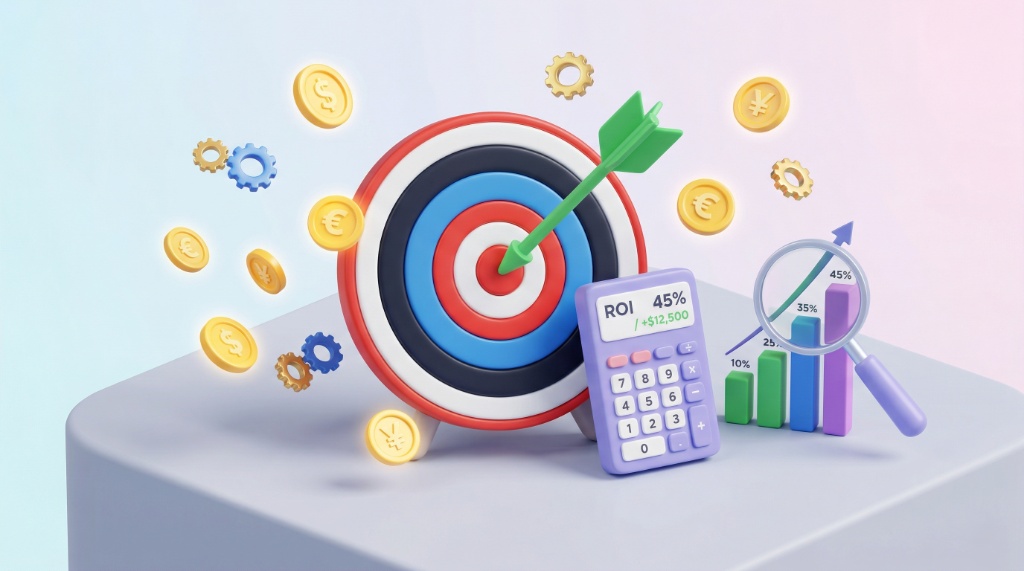
The Ultimate Truth in Finance: Measuring Success With an ROI Calculator
Every day, you are making investments. Whether you are pouring capital into a new marketing campaign, buying shares in an index fund, or spending money to upgrade your real estate, you are trading your current resources for future gains. But how do you objectively know if your strategy is actually working? Relying on raw profit numbers can be incredibly deceptive, leading you to double down on losing strategies while ignoring hidden goldmines. To strip away the emotion and reveal the pure mathematical truth of your decisions, you need a standardized metric. By running your numbers through a precise ROI calculator, you can instantly transform chaotic financial data into a clear, comparative percentage, allowing you to identify exactly where your money is working the hardest.
The Danger of Absolute Numbers: Why $10,000 Isn't Always a Win
Human brains are wired to react to absolute numbers. If someone tells you they made a $10,000 profit on a trade or a business venture, it sounds like a massive success. But without understanding the initial cost, that number is practically meaningless.
If Investor A spent $10,000 to make that $10,000 profit, they doubled their money—a phenomenal 100% Return on Investment. However, if Investor B had to spend $1,000,000 to generate that exact same $10,000 profit, their return is a microscopic 1%. Investor B took on massive risk for a return that couldn't even beat a basic savings account. Evaluating success strictly by the size of the profit blindfolds you to the efficiency of your capital.
Making Data-Driven Choices With Your ROI Calculator
The true superpower of Return on Investment is its ability to normalize completely different asset classes. It acts as a universal financial translator.
Imagine you run a small business and you have $5,000 of extra cash. You are debating between two options: launching a new Facebook ad campaign or buying a new piece of software to automate your workflow.
These seem impossible to compare. But by projecting the expected net return of the ads against the expected labor cost savings of the software, you can convert both into an ROI percentage. If the ads project a 20% ROI and the software projects a 50% ROI, the decision makes itself. You no longer have to rely on "gut feelings" or aggressive sales pitches; the math points directly to the highest yield.
The Hidden Dimension: Annualizing Your Returns
As you become more sophisticated in tracking your wealth, you will realize that a standard ROI calculation has one major blind spot: it ignores time.
Making a 50% return on an investment is fantastic. But making 50% in six months is a world-class financial achievement, whereas making 50% over the course of ten years is actually quite poor and likely loses to inflation. Smart investors always take their total return and annualize it. This breaks the growth down into a yearly rate, allowing you to accurately compare a quick stock flip with a long-term real estate hold. Mastering this time-adjusted metric is what separates amateurs from professional wealth builders.
Capital is a finite resource, and every dollar you invest has an "opportunity cost"—the money you could have made if you put it somewhere else. You cannot afford to deploy your cash blindly. Stop letting absolute numbers trick your brain into making poor financial allocations. Measure your true efficiency, optimize your portfolio, and guarantee that every dollar you spend is working as hard as possible for your future.